
TITAN World League Launches in Nancy
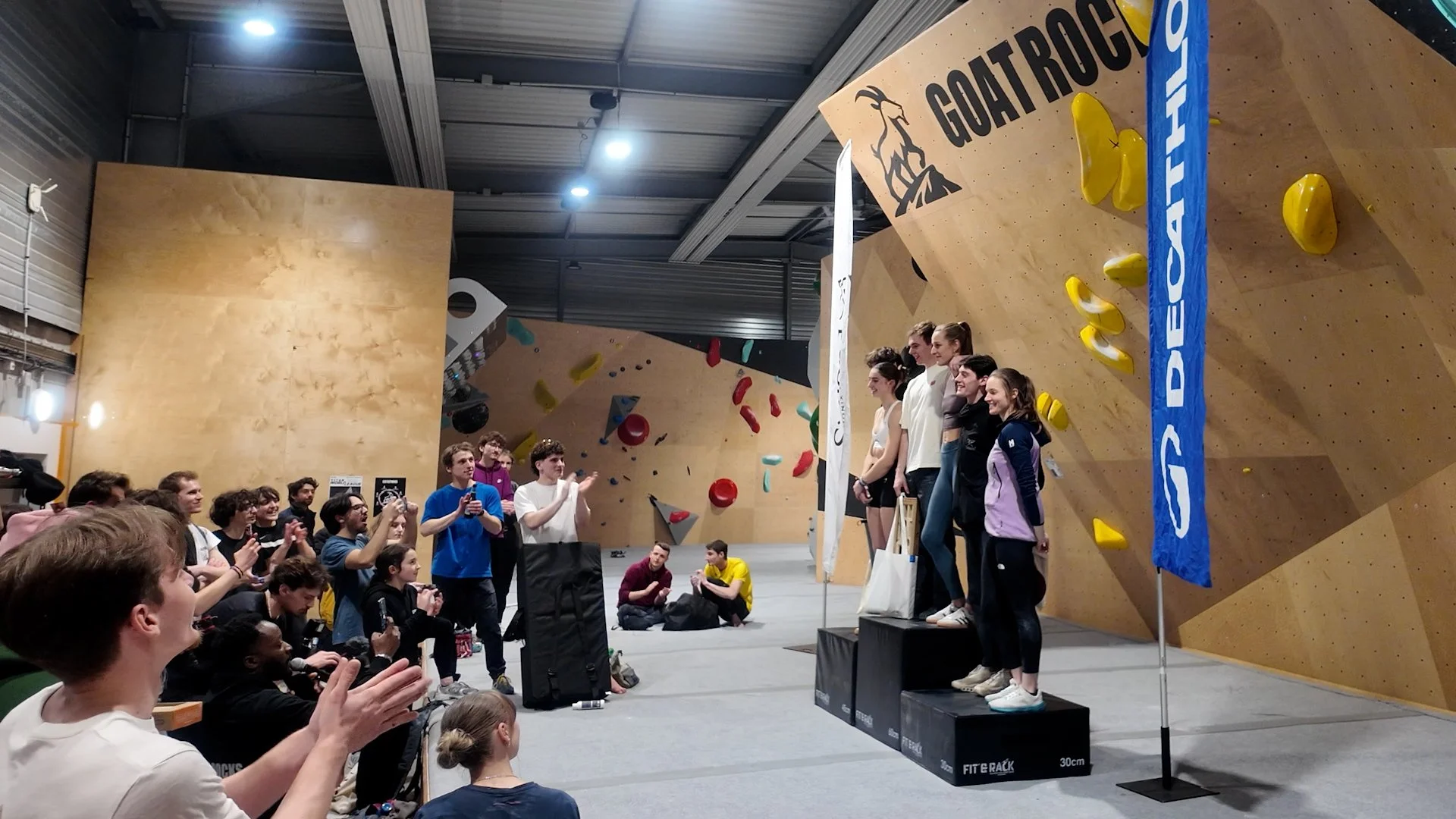
EP Climbing officially launched the TITAN World League (TWL) at Goat Rocks in Nancy, France — a soon-to-open bouldering gym and one of several facilities globally to feature the TITAN boulder wall. The League is a collaboration between EP Climbing and Circle Climbing, and powered by the Grptonite app. TWL represents an attempt to connect climbers worldwide through a shared set of boulders, without imposing a standardised competition format on gyms.
At its core, the TITAN World League introduces 14 boulders, climbed on the same wall and reproduced using Circle’s templating system. Climbers can log their ascents via Griptonite, allowing performances to be compared across participating gyms and countries — while remaining entirely optional and secondary to a gym’s normal setting programme.
A Global Reference, not a Global Rulebook
EP Climbing are clear that the TWL is not about replacing creativity or homogenising climbing. Participation is voluntary, and the League runs alongside — not instead of — a gym’s usual setting style and identity.
The boulders are designed by international route setters who are not on site, deliberately introducing unfamiliar movement styles and ideas into local gyms. The intention is not to define how climbing should look, but to introduce a shared reference point that allows climbers to experience — and compare themselves against — the same problems worldwide.
In practice:
gyms retain full control of their own setting programmes
climbers choose whether to engage with the League boulders
routesetting remains, by necessity, a creative job
The League adds a layer rather than a constraint — one that sits comfortably alongside the diversity that defines modern indoor climbing.
Local Rivalry Within a Global Framework
From ECN’s perspective, one of the more compelling aspects of the TITAN World League is its “global yet local” nature. Climbers are not competing for centralised prizes or podiums, but instead engaging in friendly rivalry with others across borders — often without leaving their home gym.
At present, there appears to be no fixed season length or formal prize structure, and no centrally organised winners announced by EP Climbing or Circle. It seems more likely that recognition will happen at a gym level, at least initially. That may evolve if uptake increases and the concept proves scalable across a wider network of gyms.
Engagement, Fatigue, and the Question of Time Limits
With a macro view of how climbing gyms run internal leagues and challenges, ECN has often observed a familiar issue: engagement fatigue. When leagues stretch on for months — or even an entire year — enthusiasm can drop as rounds blur together.
It will be interesting to see how gyms manage TWL participation over time, and whether they choose to introduce clear end points, seasonal resets, or periodic refreshes of the League boulders to maintain momentum. How this is handled may prove as important as the concept itself.
A Boost for Underused Competition Walls
Another potential benefit lies in traffic flow within gyms. Competition-style walls are often intimidating spaces for everyday climbers, dominated by large volumes and visually imposing ‘king lines’ that see less traffic than expected.
An initiative like the TITAN World League gives gyms a strong reason to activate these spaces, encouraging climbers of varying abilities to engage with a wall they might otherwise avoid. In that sense, the League may offer operational value beyond the novelty of global comparison.
Templates, Training, and the Future of Routesetting
A discussion with Jérôme Meyer, founder of Circle Climbing, also highlighted the longer-term implications of selling boulders as templates. While the idea is not without controversy, ECN sees potential value — particularly at a time when experienced routesetters are increasingly in demand as more gyms open.
For some gym owners and head setters, purchasing templates could:
support the training of newer setters
expose teams to unfamiliar movement styles
broaden a gym’s setting repertoire without sacrificing quality
One possible model is educational: a team sets a template boulder to understand the intended movement and logic, then adapts it — making it easier or harder while preserving the core idea. Rather than replacing creativity, templates could accelerate learning.
There is also the possibility that setters themselves may eventually catalogue and sell their own boulders, creating a marketplace for movement ideas — not unlike Etsy, but for routesetting.
An Operational Detail Setters Shouldn’t Ignore
One practical consideration emerged during a light-hearted routesetting competition at the Salon de l’Escalade in Paris. When holds are repeatedly mounted in exactly the same position, screw holes can quickly lose their bite, sometimes to the point where holds can be pulled off the wall with surprisingly little force.
Meyer noted that TWL blocs can tolerate up to 50mm of variation from “perfect placement” while still climbing largely as intended. Setters should be mindful of this flexibility, deliberately avoiding identical placements to reduce wear and improve safety — an important operational takeaway as standardised problems are reset multiple times.
A Concept Worth Watching
The TITAN World League does not attempt to redefine indoor climbing overnight. Instead, it proposes a modest but intriguing idea: shared movement, globally connected, locally controlled.
As more gyms adopt the TITAN wall and experiment with the League format, the real test will be how well it balances engagement, creativity, and operational reality. For now, it is an innovation that deserves time — and close observation.
